
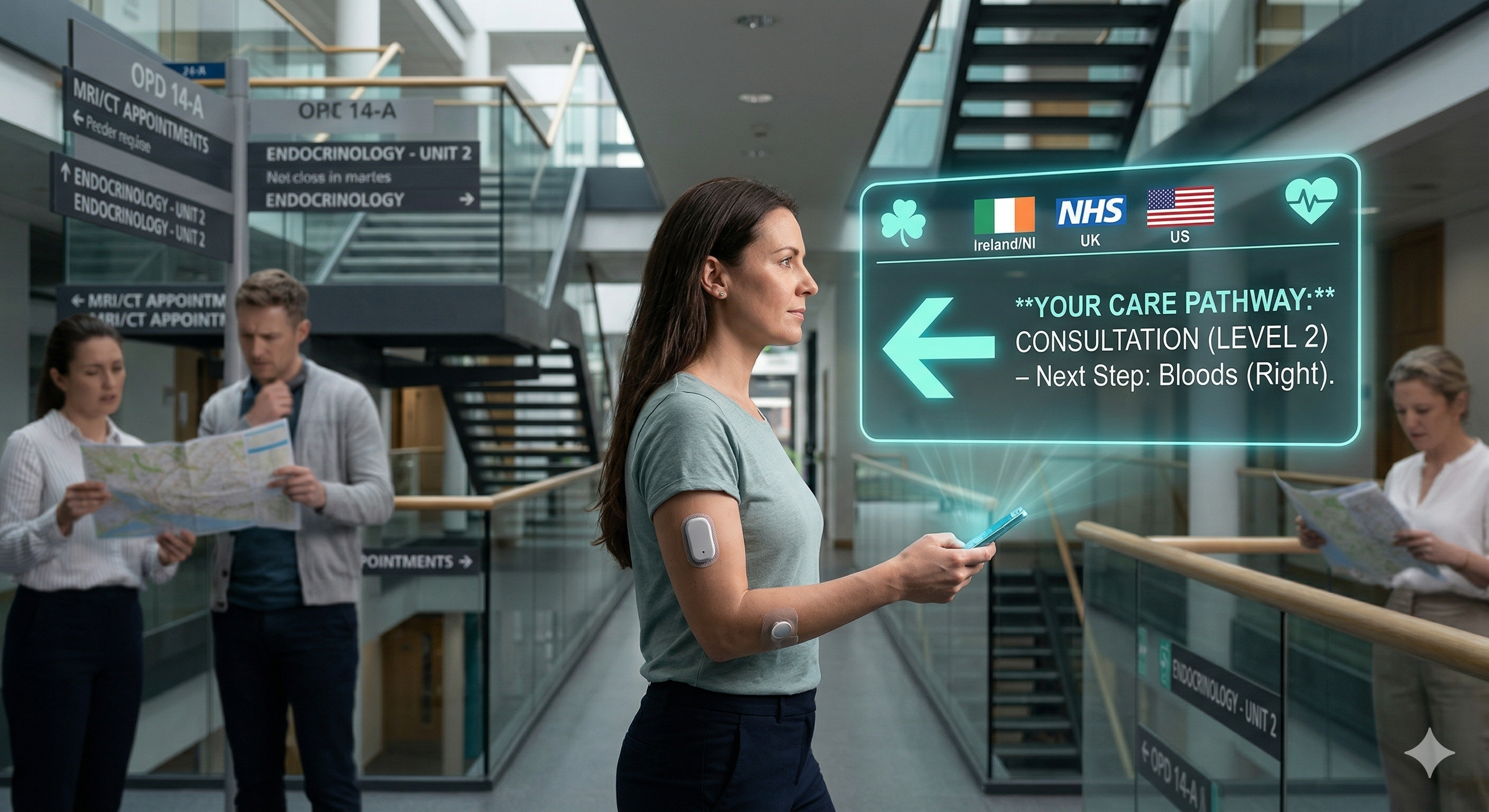
In my previous article, we explored the “invisible barrier” of medical jargon—how the words doctors use can often feel like a foreign language. But understanding the words is only half the battle. Once you know what is wrong, you face an even more daunting challenge: the care pathway.
If health literacy means reading the signs, navigating a care pathway is like driving through a city with no GPS and ever‑changing routes. In cities like Dublin, Belfast, London, or New York, the journey from symptom to recovery is rarely straightforward.
Now, as we shift from understanding the challenge to exploring differences, let’s look at how patients navigate these mazes in the UK, Ireland, and the US, and how we can build clearer maps.
The “Waiting Room” Dilemma: Ireland and Northern Ireland
Ireland and Northern Ireland’s pathways are defined by a “two‑tier” system and extensive waiting lists.
Ireland: The Sláintecare Transition
In the Republic of Ireland, the transition toward Sláintecare—a strategy intended to create a universal, single‑tier health service—is still in a critical phase. Recent 2025 data from the Health System Performance Assessment (HSPA) indicates that while digital integration has improved, the “navigation burden” remains high.
The Literacy Gap
For those in lower socioeconomic brackets, the “pathway literacy” is even lower. Research from Dublin City University & collaborators (2025) shows that patients in disadvantaged community areas are significantly more likely to experience a “fragmented” care journey, where records are not shared consistently between their GP and the hospital. The 35% figure for difficulty in service selection rises sharply among these communities, leading to overcrowding in Emergency Departments (EDs).
Northern Ireland: The Encompass Revolution
North of the border, the 2024/2025 rollout of the encompass integrated‑care‑record programme has begun to bridge this gap. By giving every citizen a single digital record, the pathway is finally becoming visible.
Progress With Persistent Hurdles
However, health literacy remains a hurdle. A 2025 patient‑feedback update from the Health and Social Care (HSC) in Northern Ireland notes that a substantial minority of patients still feel “overwhelmed” by the number of appointments and different clinicians they must see for a single chronic condition. The technology is ahead of the patient education; the map exists, but many patients do not yet know how to read it.
The UK: The Postcode Lottery and Integrated Care
In the UK, the NHS has moved to Integrated Care Boards (ICBs) to create more seamless pathways, but for many, it remains a “postcode lottery.”
Key Navigation Disparities in the UK
- The Navigation Gap: According to analysis by The Health Foundation, individuals living in the most deprived 10% of areas in England are more likely to experience delays in referral‑to‑treatment pathways due to administrative errors and fragmented communication.
- Racial Disparities in Navigation: Data linked to NHS England’s Core20PLUS5 equality‑improvement programme (2025) reveal that Black and South Asian patients are 15–20% less likely to be successfully steered onto preventive care pathways for cardiovascular disease compared with their White counterparts, often because of a lack of culturally tailored navigation support.
- System Fluency: When the system assumes everyone has the same level of “system fluency”—the ability to chase referrals, use apps, and advocate for oneself—it inadvertently leaves the most vulnerable behind.
The shift to ICBs represents genuine structural progress. Yet structural reform alone cannot close the navigation gap if the human interface—clear communication, culturally sensitive support, and digital accessibility—does not keep pace.
The US: The Administrative Burden
In the United States, the care pathway is not just a clinical journey; it is also a financial and administrative one. Navigating “in‑network” versus “out‑of‑network” providers adds a layer of complexity that does not exist to the same extent in Europe.
The “Paperwork” Penalty
A 2025 Health Affairs‑adjacent analysis notes that US adults spend an average of around 12 hours per year dealing with health insurance and administrative tasks, ranging from prior authorisations to claims processing. Among Hispanic and Latino populations, studies of health insurance literacy show that between 50% and 70% of adults report low or poor understanding of insurance‑related requirements, which contributes to delayed or forgone care.
The 2026 Reality
Even with the expansion and ongoing adjustment of Affordable Care Act (ACA)‑aligned frameworks, significant proportions of US adults remain “under‑insured”—not because they lack coverage, but because they do not know how to navigate the pathway to use the coverage they have. The barrier is not access in the traditional sense; it is navigational capacity.
Building a Better Map: The Role of Digital Navigators
We cannot simply expect patients to become overnight experts in hospital administration. The solution lies in system navigation technology.
1. AI Care Navigators
In 2026, “Digital Navigators”—AI tools embedded within patient portals—can guide patients step‑by‑step. Instead of wondering about scan results, the AI proactively informs: “Your results are in. Your next step is a 15‑minute telehealth consult. Click here to book.” These tools reduce the cognitive load on patients by transforming a passive, confusing system into an active, guided experience. They meet patients where they are, rather than expecting patients to find their own way.
2. Unified Health Identities
Whether it is the Individual Health Identifier (IHI) in Ireland or the NHS Login in the UK, the goal is a “Single Source of Truth.” When a patient moves from a GP to a specialist, the map should move with them. The encompass programme in Northern Ireland is already demonstrating this: a single digital record means that every clinician a patient encounters is looking at the same map. Fragmented journeys stem from fragmented data; unified identities are the prerequisite for a joined‑up pathway.
3. Social Prescribing Portals
Many pathways to health do not lead to a pharmacy; they lead to the community. Digital platforms are now linking clinical care to social prescribing—connecting patients with exercise groups, mental health support, or housing advice, all tracked within the same digital journey. This is a paradigm shift: the care pathway is no longer exclusively medical. It is holistic, and technology is the connective tissue.
The Final Hurdle: Empathy‑First Design
As we build these digital maps, we must remember the “Inverse Care Law”: the availability of good medical care tends to vary inversely with the need for it in the population served.
The Risk of High-Tech, Low-Empathy Solutions
If we create a highly efficient, high‑tech care pathway that requires a £1,000 smartphone and a PhD to navigate, we have not solved the problem; we have just modernised the barrier. True health literacy means the pathway should be so intuitive that it requires minimal “literacy” at all. It should be a guided tour, not a self‑guided trek through the wilderness.
Empathy‑first design means building with the most vulnerable user in mind, not the most digitally confident. It means testing care navigation tools with older adults, non‑native speakers, and those with low digital literacy before rolling them out at scale. It means measuring success not by the sophistication of the technology, but by whether a 75‑year‑old in rural Donegal or a recent immigrant in South London can use it without a helpdesk.
The goal for 2026 and beyond? To ensure that your “postcode” or “zipcode” does not determine the quality of your map.
References
- Dublin City University / Health Literacy in Ireland research group. (2025). Health literacy in Ireland: insights from rural and urban community perspectives. European Journal of Public Health, 35(3), 400–405.
- Department of Health, Northern Ireland / Health and Social Care (HSC). (2025). encompass: From implementation to impact – A new era for health and social care in Northern Ireland.
- The Health Foundation. (2025). Equity in access: Administrative burden and health inequalities in England.
- NHS England. (2025). Core20PLUS5 – An approach to reducing health inequalities for adults (and children and young people). NHS England.
- Health Affairs (Scholar) & related Health Affairs work. (2026). Brokering a new path: Navigating administrative burdens in the U.S. health insurance marketplace. Health Affairs Scholar, 4(2), qxag017.
- Kaiser Family Foundation (KFF). (2025). Health and health care for Hispanic people. Kaiser Family Foundation.
- Sørensen, K., et al. (2024). Health literacy is a human rights concern: Expert report on health literacy. Council of Europe / European Health Literacy Network.