
When we talk about healthcare, the conversation usually revolves around physical access: getting an appointment, paying for a consultation, or waiting on a list for a specialist. However, there is an invisible barrier that affects millions of us every day, dictating the quality of our care long after we leave the doctor's office. That barrier is health literacy.
Health literacy is not a reflection of your general intelligence or how many university degrees you hold. It is specifically defined as your personal ability to find, understand, critically evaluate, and use health information to make informed decisions about your well-being. And as it turns out, navigating medical jargon is a universal struggle.
Let's take a friendly, data-driven look at the current state of health literacy in Ireland, the United Kingdom, and the United States; the hidden costs of medical confusion; and how modern technology is stepping up to serve as the ultimate medical translator.
How Health Literate Are We?
You might naturally assume that in wealthy, developed nations with high overall educational attainment, health literacy would be high across the board. However, the statistics tell a very different story.
Ireland: The 40% Challenge
In Ireland, engaging with the healthcare system can be a complex dance between public services and private health insurance. But beyond the logistics of access, understanding the care itself remains a significant hurdle.
According to the European Health Literacy Survey (HLS-EU) and recent comprehensive reports led by Dublin City University (DCU), approximately 40% of adults in Ireland have limited or inadequate health literacy.
Impact on Everyday Life
This limitation has a profound impact on everyday life. It affects an individual's ability to effectively manage personal health, engage with preventative screening programmes, and interact confidently with healthcare services. When 4 in 10 people struggle to interpret basic health advice, public health initiatives—from vaccination drives to chronic disease management—face an uphill battle.
United Kingdom: The Numeracy Gap
The National Health Service (NHS) is built on the principle of being free at the point of use and is designed to be accessible to everyone. Yet the information in the system is not always as accessible as the clinics themselves.
Data highlighted by Public Health England and NHS England reveal a stark reality: 43% of working-age adults in England struggle to understand standard text-based health information.
The Numeracy Problem
Crucially, when numerical information is introduced—such as calculating medication dosages, understanding risk percentages, or reading nutrition labels—that figure jumps to an astonishing 61%. This means that well over half the population may leave a consultation unable to safely or effectively act on the mathematical instructions they were given. The NHS rightly identifies this as a critical "systems issue," warning that poor health literacy inadvertently widens health inequalities, disproportionately affecting socially and economically disadvantaged communities.
United States: The Complexity Crisis
The US healthcare system is notorious for its complexity. It is an intricate, high-stakes maze of premiums, co-pays, deductibles, and "in-network" providers. Navigating this requires a massive cognitive load before you even get to the clinical advice.
The gold-standard data from the National Assessment of Adult Literacy (NAAL) paints a concerning picture: only 12% of US adults have "proficient" health literacy skills. Furthermore, roughly 36% of adults possess only "basic" or "below basic" health literacy. In a system where making the wrong choice can lead to immense medical debt or a denial of coverage, lacking the skills to decipher complex medical and insurance documents is incredibly dangerous.
The data also highlights a severe demographic divide, with limited health literacy disproportionately impacting older adults, minority groups, and those relying on public assistance programmes like Medicaid.
The Hidden Cost of Confusion
Why do these numbers matter so much? Because a simple misunderstanding at the pharmacy counter or confusion over a post-surgery discharge summary can have severe, real-world consequences.
Research consistently shows that individuals with limited health literacy face a cascade of negative outcomes:
Consequences of Low Health Literacy
- Preventative Care: They are significantly less likely to engage in preventative measures, such as taking up cancer screenings or getting seasonal flu jabs.
- Medication Errors: They are more likely to misuse medications. Misunderstanding instructions like "take on an empty stomach" or "take twice daily" can render treatments ineffective or dangerous.
- Emergency Admissions: They are far more likely to end up in the Accident and Emergency (A&E) department and to be readmitted to the hospital within 30 days of discharge.
- Chronic Disease: Conditions like diabetes or hypertension, which require daily self-management and monitoring, are poorly controlled.
Ultimately, low health literacy leads to poorer health outcomes, higher mortality rates, and significantly higher financial costs for both the patient and the healthcare system.
How Technology is Rewriting the Prescription
This is where the digital revolution is making a tangible difference. We are slowly moving away from handing patients a dense, text-heavy pamphlet and expecting them to figure it out on their own. Digital Health Interventions (DHIs) are fundamentally changing how we consume, understand, and interact with our health data.
Here is how technology is bridging the comprehension gap and empowering patients:
1. Artificial Intelligence as a Medical Translator
Have you ever tried to read your own blood test results or a consultant's letter? Terms like hyperlipidaemia, idiopathic, or contraindication can induce unnecessary panic. Today, patient-directed Generative AI tools are empowering individuals to translate complex clinical jargon into plain, everyday language. Patients can securely input their doctors' notes and ask the AI to explain their diagnosis as if they were speaking to a friend, summarise their treatment plan, or even draft questions to ask at their next appointment.
2. Patient Portals and Electronic Health Records (EHRs)
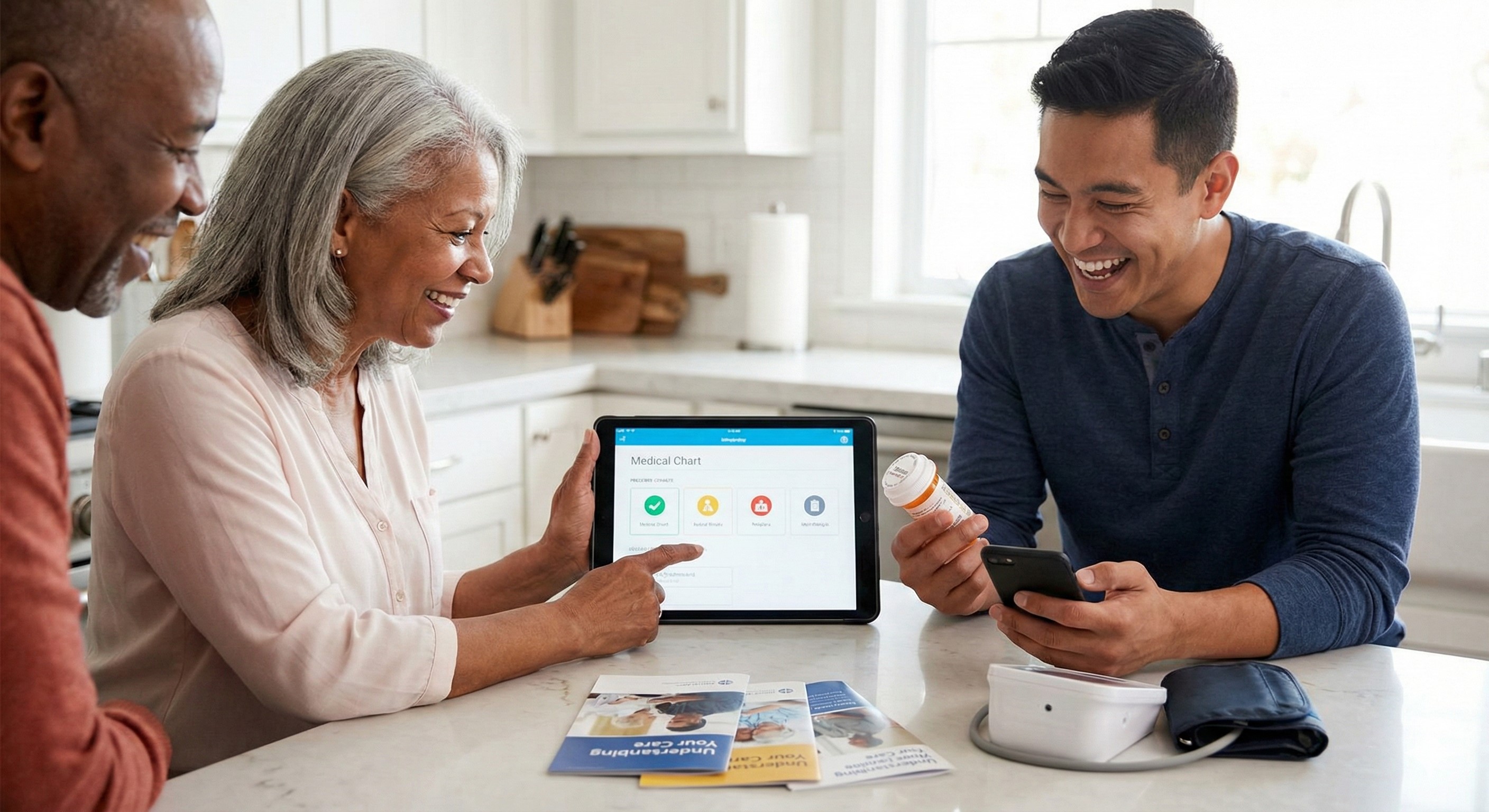
Gone are the days when your medical history lived exclusively in a manila folder behind a receptionist's desk. Systems like the NHS App in the UK and digital portals like MyChart, used by major US hospital networks, allow patients to view their records, track their immunisations, and read consultation notes in real time. Having the ability to review this information at home—without the pressure, anxiety, and time constraints of the GP surgery—gives patients the breathing room they need to process and understand their care.
3. Multimedia and Gamification
Text is not always the best teacher, especially for the 61% of adults who struggle with numerical health data. Many digital health apps now use interactive videos, 3D animations, and gamification to explain health concepts. For example, apps designed for newly diagnosed diabetic patients often use culturally adapted video education to explain blood sugar monitoring. Seeing a visual demonstration of how to use an insulin pen is infinitely more effective than reading a six-page instruction manual.
4. Wearables and Real-Time Feedback
Devices like smartwatches, fitness trackers, and Continuous Glucose Monitors (CGMs) do not just collect data; they interpret it. Instead of a doctor vaguely telling a patient to "exercise more and watch their diet," a wearable device provides real-time, visual feedback. It translates the abstract concept of "heart health" or "blood sugar" into a daily, understandable, and actionable metric. It makes the invisible visible.
The Digital Divide
As much as we celebrate these technological advancements, we must also acknowledge a significant caveat: Digital Health Literacy.
Digital health literacy is the critical overlap between standard health literacy and digital skills. It is the ability to search for, securely evaluate, and confidently use health information from electronic sources.
Risks of the Digital Divide
- If we move all our healthcare resources online and replace receptionists with touch-screens, we risk leaving behind the most vulnerable groups—often the elderly, those from lower socioeconomic backgrounds, and non-native speakers.
- Studies show that a "digital divide" can actually widen health inequalities if we are not careful.
- NHS England estimates that around 10 million adults lack foundation-level digital skills, making online appointment booking a source of stress rather than convenience.
To prevent this, healthcare providers and app developers must focus relentlessly on User-Centred Design. This means creating apps that are incredibly intuitive, culturally sensitive, and accessible to people with visual or cognitive disabilities. It also means healthcare systems must invest in community programmes—like upskilling initiatives in local libraries—that teach basic digital skills alongside health education.
Final Thoughts
The statistics across Ireland, the UK, and the US paint a remarkably clear picture: our medical systems are inherently complex, and the average person struggles to navigate them without guidance.
However, technology offers a highly promising solution. By translating medical jargon into plain English, visualising complex data, and putting medical records directly into our pockets, digital health tools are slowly shifting the power back to the patient.
The Ultimate Goal
The ultimate goal of healthcare innovation isn't just to make us physically healthier; it is to make us more confident, informed, and empowered when we take charge of our own care.
References
- Dublin City University (DCU) & Sláintecare. (2024). Healthy Communities Health Literacy Report.
- Sørensen, K., Pelikan, J.M., Röthlin, F., et al. (2015). Health literacy in Europe: comparative results of the European health literacy survey (HLS-EU). The European Journal of Public Health, 25(6), pp.1053-1058.
- Rowlands, G., Protheroe, J., Winkley, J., et al. (2015). A mismatch between population health literacy and the complexity of health information. The British Journal of General Practice, 65(635), p.e379.
- Public Health England. (2015). Improving health literacy to reduce health inequalities. GOV.UK Briefing.
- Kutner, M., Greenburg, E., Jin, Y. and Paulsen, C. (2006). The Health Literacy of America's Adults: Results from the 2003 National Assessment of Adult Literacy. NCES 2006-483.
- Lopez, C., Kim, B. and Sacks, K. (2022). Health literacy in the United States: Enhancing assessments and reducing disparities.